White Paper
Superconducting Electronics Has a Memory Problem
How cold memory can speed up superconducting computers and untangle the wiring of quantum machines
Summary
Superconducting computers can run very fast on very little power, but they lack one thing every useful computer needs: enough fast memory close by. Without it, a superconducting processor spends most of its time waiting.
- Memory sets the speed of computing. Since the first stored-program computers of the 1940s, a processor can only work as fast as its memory feeds it instructions and data.
- Superconducting electronics (SCE) cannot yet make dense memory. Today’s superconducting chips hold only a small amount of memory, so most data lives far away, outside the super-cold container (the cryostat) where the processor runs.
- Each trip outside is costly. In the system we model, a processor running at 30 GHz waits about 1,363 clock cycles every time it must fetch something from warm memory.
- A hybrid fixes most of this. Placing a 512 KB cache built from cryo-CMOS memory (ordinary chip technology designed to run cold) inside the cryostat, next to the superconducting processor, makes the system about 6× faster (5.4–6.2× in our model).
- It also cuts wiring. Because most requests are now answered inside the cryostat, 10–100× fewer cables need to cross into it.
- Similar ideas can help quantum computers. Today, thousands of cables run from room temperature down to the qubits. Putting memory, control and readout in the cold stages could untangle this “wiring wall,” one of the largest fixed costs per qubit.
QNantix, Inc. holds patented and patent-pending intellectual property in cryo-CMOS, superconducting and hybrid circuits and systems aimed at exactly this problem.
1. Why computers are going cold
Some of the most promising computers of the next decade will run colder than outer space. Quantum computers, sensitive quantum sensors and a new class of superconducting processors all work only near absolute zero, the coldest temperature possible.
Superconductivity in one paragraph
In an ordinary wire, electrons bump into atoms as they flow, losing energy as heat. Cool certain metals far enough, and that resistance vanishes completely: current flows with no loss at all. This is superconductivity. Circuits built this way, called superconducting electronics (SCE), can switch tens of billions of times per second while using a tiny fraction of the power of today’s chips.
Temperature is measured in kelvin
Scientists measure these temperatures in kelvin (K). Zero kelvin is absolute zero, about −273 °C (−460 °F). Room temperature is about 300 K. Liquid nitrogen boils at 77 K, and liquid helium at about 4 K. The qubits in many quantum computers sit at about 10 millikelvin (mK), or one hundredth of a kelvin.
The cryostat is a staircase
A cryostat (or dilution refrigerator) is the machine that keeps things this cold. It is built like a staircase of nested stages, each colder than the one above: roughly 300 K at the top, then 50 K, 4 K, 100 mK, and finally about 10 mK at the bottom. Each step down is harder to keep cold, because the cooling power available at each stage shrinks sharply as the temperature falls.
That staircase shapes everything in this paper. Every wire that runs down it carries a little heat with it. Every chip placed on a stage must fit within that stage’s small cooling budget. And every piece of data that must travel up the staircase and back costs time.
2. A few words we will use
The argument in this paper rests on a handful of ideas from computer design. An everyday picture makes them easy.
The desk, the bookshelf and the library
Imagine writing a research report. The books you are using right now sit open on your desk: tiny, but within arm’s reach. A bookshelf across the room holds more, and fetching from it takes a short walk. Everything else is in a library across town: it holds every book, but each trip takes an hour.
A computer works the same way. The processor’s smallest, fastest memory is the desk. A larger, slightly slower memory is the bookshelf. Main memory, which holds everything, is the library. The whole design goal is to keep what you need on the desk or the bookshelf, so you rarely drive to the library.
The terms
| Term | What it means | In the analogy |
|---|---|---|
| Instruction | One simple step a processor carries out, such as “add these two numbers.” Programs are long lists of instructions. | One line of your report |
| Clock cycle | The processor’s heartbeat. At 30 GHz (30 billion beats per second), one cycle lasts about 33 picoseconds. | The tick of a clock |
| Main memory | Large memory holding all of a program’s instructions and data. Big but slow to reach. | The library |
| Cache | A small, fast memory close to the processor that keeps copies of what is in use right now. | The desk |
| L1 and L2 cache | Levels of cache. L1 is the smallest and fastest, inside the processor. L2 is larger and a little slower. | Desk (L1), bookshelf (L2) |
| Hit | The processor finds what it needs in the cache. | The book is on your desk |
| Miss | The item is not in the cache, so it must be fetched from a farther level. | You have to go get the book |
| Miss rate | How often misses happen, counted per instruction. “One miss every 10 instructions” is a miss rate of 0.1 misses per instruction. | How often you leave the desk |
| Miss penalty (latency) | How many clock cycles the processor waits for one miss to be served. | How long each trip takes |
| CPI (cycles per instruction) | The average number of clock cycles each instruction takes, including time spent waiting on misses. Lower CPI means a faster computer. A CPI of 1 means one instruction per beat; a CPI of 137 means most beats are spent waiting. | Minutes per line of your report |
| Working set | The instructions and data a program is actively using over a stretch of time. If the working set fits in the cache, misses are rare. | The books you need this week |
| CMOS | The standard chip technology inside nearly every phone and computer today. | |
| Cryo-CMOS | CMOS chips designed to run at cryogenic temperatures (about 1–77 K). | |
| SCE | Superconducting electronics: circuits with zero electrical resistance, very fast and very low power. | |
| Hybrid | A design that combines cryo-CMOS and SCE, on one chip or as separate chips working together. |
The one formula in this paper
One simple rule ties these terms together. The average CPI is the CPI a processor would achieve if it never missed, plus the cost of each kind of miss:
CPI = CPI∞ + Σ (misses per instruction × miss penalty)
Here CPI∞ (“CPI with an infinite cache”) is the speed with no misses at all; we take it to be 1. The sum adds up one term for each place a miss can be served. In words: every miss adds its waiting time, spread across the instructions in between. If a processor misses once every 10 instructions and each miss costs 150 cycles, the misses add 150 ÷ 10 = 15 cycles to every instruction, on average.
3. A link to the classical past: why memory sets the speed
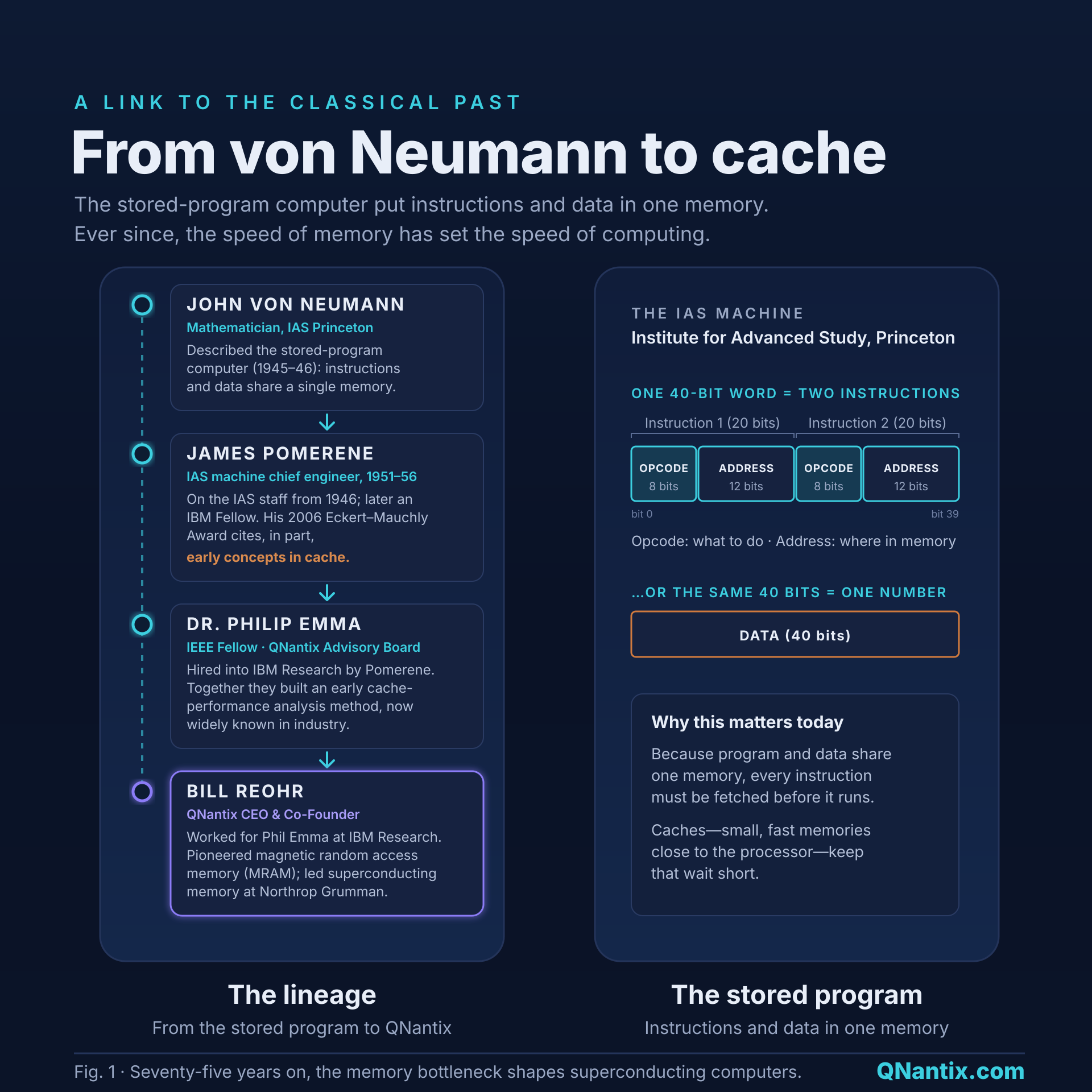
The memory problem is as old as the modern computer. In 1945 and 1946, the mathematician John von Neumann and his colleagues described the stored-program computer: a machine that keeps its program in the same memory as its data. You change what the computer does by loading new instructions, not by rewiring it. Nearly every computer since works this way.
The team built this design at the Institute for Advanced Study (IAS) in Princeton. The IAS machine began running in 1952. Each 40-bit memory word could hold either one number or two instructions. Each instruction had an 8-bit opcode (what to do) and a 12-bit address (where in memory to find the data).
That elegant design has a built-in catch. Because instructions and data share one memory, the processor must fetch every instruction, and most of its data, from memory before it can act. If memory is slow, the processor waits. Computer scientists later named this the “von Neumann bottleneck,” and caches were invented to ease it.
A direct line to QNantix
- John von Neumann described the stored-program architecture.
- James Pomerene joined the IAS computer project in 1946 and was its chief engineer from 1951 to 1956. He later became an IBM Fellow. His 2006 Eckert–Mauchly Award, computer architecture’s top honor, cites in part his “early concepts in cache.”
- Dr. Philip Emma was hired into IBM Research by Pomerene. Together they developed a method for analyzing how caches affect processor performance. IBM kept the work confidential for years, but the method is now widely known in industry. Dr. Emma is an IEEE Fellow and a member of the QNantix Technical Advisory Board.
- Bill Reohr, QNantix CEO and co-founder, worked for Dr. Emma at IBM Research. He pioneered magnetic random access memory (MRAM) and later led superconducting memory development at Northrop Grumman.
The analysis in the next sections applies the Pomerene–Emma method to superconducting computers.
4. Measuring the cost of a miss
The Pomerene–Emma method answers one question: how many clock cycles does a processor lose to cache misses? We use it to compare two superconducting systems that differ in just one way, namely where a miss is served.
The system we model
- Eight superconducting processor cores running at 30 GHz, so one clock cycle lasts about 33 picoseconds.
- With a perfect cache, each core would finish one instruction per cycle (CPI∞ = 1). As we will see, this number barely matters.
- Each core has a 2 KB L1 instruction cache. That is tiny by modern standards, and manufacturing yield is the reason. A superconducting chip can be made reliably only if it holds a limited number of devices, so little room is left for memory, and the L1 cache stays small.
- A cache this small misses once every 8 to 12 instructions. This range comes from well-established measurements of server software. Code that controls qubits or processes signals is likely to behave better, so these numbers are cautious.
- Main memory sits outside the cryostat. A round trip to it takes about 45 nanoseconds, or 1,363 cycles at 30 GHz. Published estimates put this delay at 30 ns or more; we use 45 ns.
Reading the plot
Figure 2 turns the formula from Section 2 into a picture. The horizontal axis is the miss rate (misses per instruction). The vertical axis is CPI. Each line shows the cost of misses served from one place, and its slope is the miss penalty: the steeper the line, the longer each miss takes.
- The steep copper line is a miss served by main memory, at 1,363 cycles each.
- The shallow cyan line is a miss served by a cold L2 cache inside the cryostat, at 152 cycles each.
Both systems miss their L1 cache equally often; we show one miss every 10 instructions. The difference is which line each system lands on:
- Point 1, all-SCE system. Every L1 miss goes to main memory. CPI = 1 + 1,363 ÷ 10 ≈ 137.
- Point 2, hybrid system. The same misses are served by the cold L2. They add only 152 ÷ 10 ≈ 15 to CPI.
- Point 3, hybrid system. The L2 sometimes misses too, about once every 180 instructions, and those trips still go to main memory. They add 1,363 ÷ 180 ≈ 8.
Adding up, the hybrid’s CPI is about 1 + 15 + 8 ≈ 24, compared with 137. That is about 5.8× faster, with the same processor and the same L1 cache.

5. Two systems: all-superconducting vs. hybrid
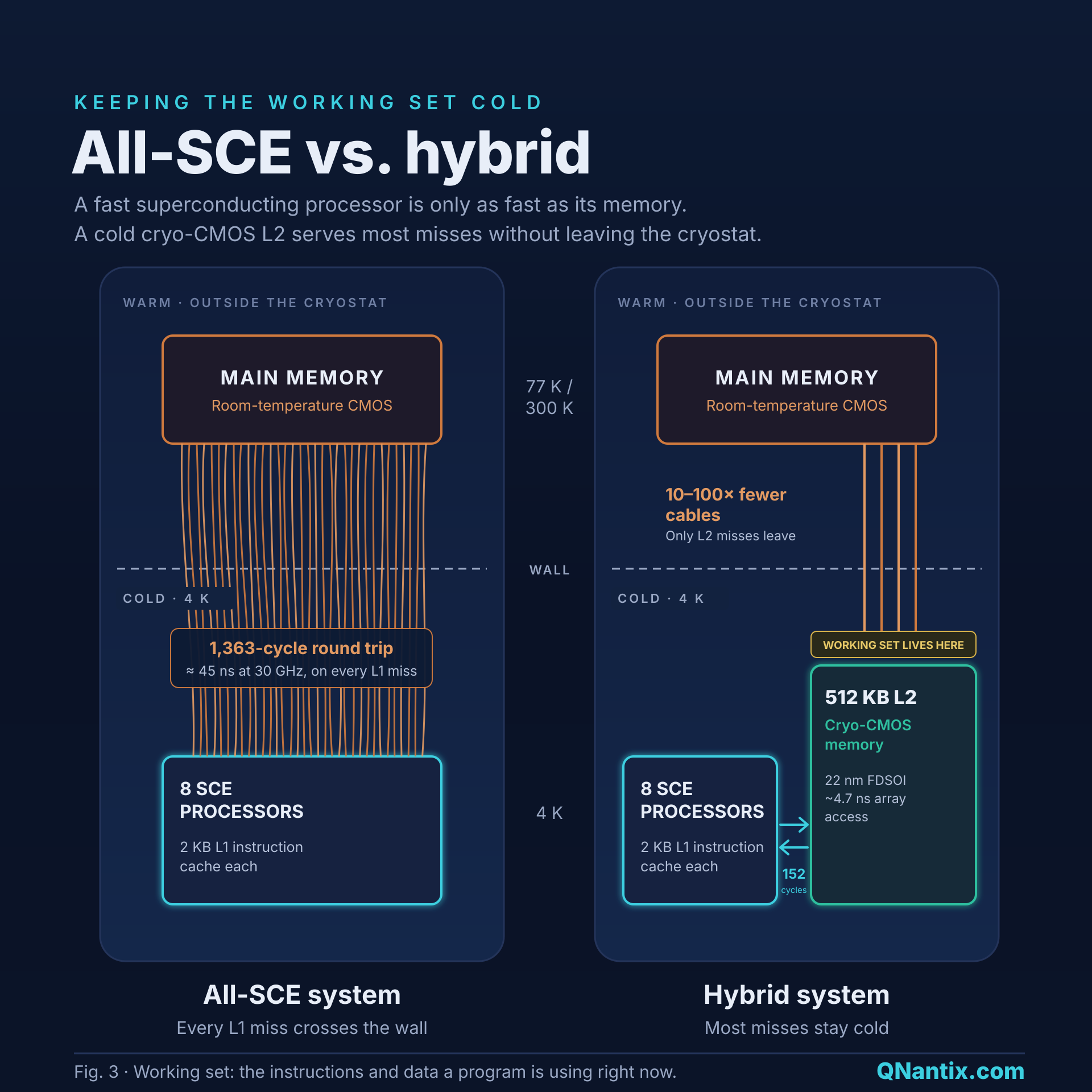
Figure 3 shows the two systems side by side. Both have the same eight superconducting cores at 4 K and the same main memory outside the cryostat. The only difference is a cache in the middle.
The all-SCE system: every miss leaves the cryostat
In the all-superconducting system, the cores’ 2 KB caches hold only a sliver of the working set. The rest lives in main memory, beyond the cryostat wall. So every L1 miss becomes a 1,363-cycle round trip.
Worse, these simple cores can handle only one miss at a time. When a miss happens, the core simply stops and waits for the answer. At one miss every 8, 10 or 12 instructions, the CPI is:
CPISCE = (1,363 + N) ÷ N ≈ 171, 137, 115 for N = 8, 10, 12
where N is the number of instructions between misses. In plain terms, the processor spends more than 99% of its time waiting. Its speed is set almost entirely by the distance to memory, not by how fast its superconducting circuits switch.
The hybrid system: keep the working set cold
The hybrid system adds one part: a 512 KB L2 cache built from cryo-CMOS memory, placed at 4 K right next to the cores. In the analogy, it is a bookshelf in the same room as the desk.
Why cryo-CMOS and not superconducting memory? Superconducting circuits are fast and frugal, but manufacturing yields still limit how many devices fit on a chip, so dense superconducting memory remains years away. CMOS, by contrast, packs billions of memory cells onto a chip today, and it can be designed to work at 4 K. A hybrid uses each technology for what it does best: SCE for fast logic, cryo-CMOS for dense memory.
In our model, the L2 is built in a 22 nm FDSOI CMOS process (a mature chipmaking technology well suited to cold operation), with an array access time of about 4.7 ns. Adding the time to pass signals between the superconducting and CMOS sides gives an L2 latency of about 152 cycles at 30 GHz. That is nine times shorter than the trip to main memory.
The L2 is large enough to hold most of the working set, so most L1 misses now end at the bookshelf. Only the rare L2 misses, about one every 180 instructions, still travel to main memory. The hybrid’s CPI becomes:
CPIhybrid = 1 + 152 ÷ N + 1,363 ÷ 180
6. Results: about 6× faster, with far fewer cables
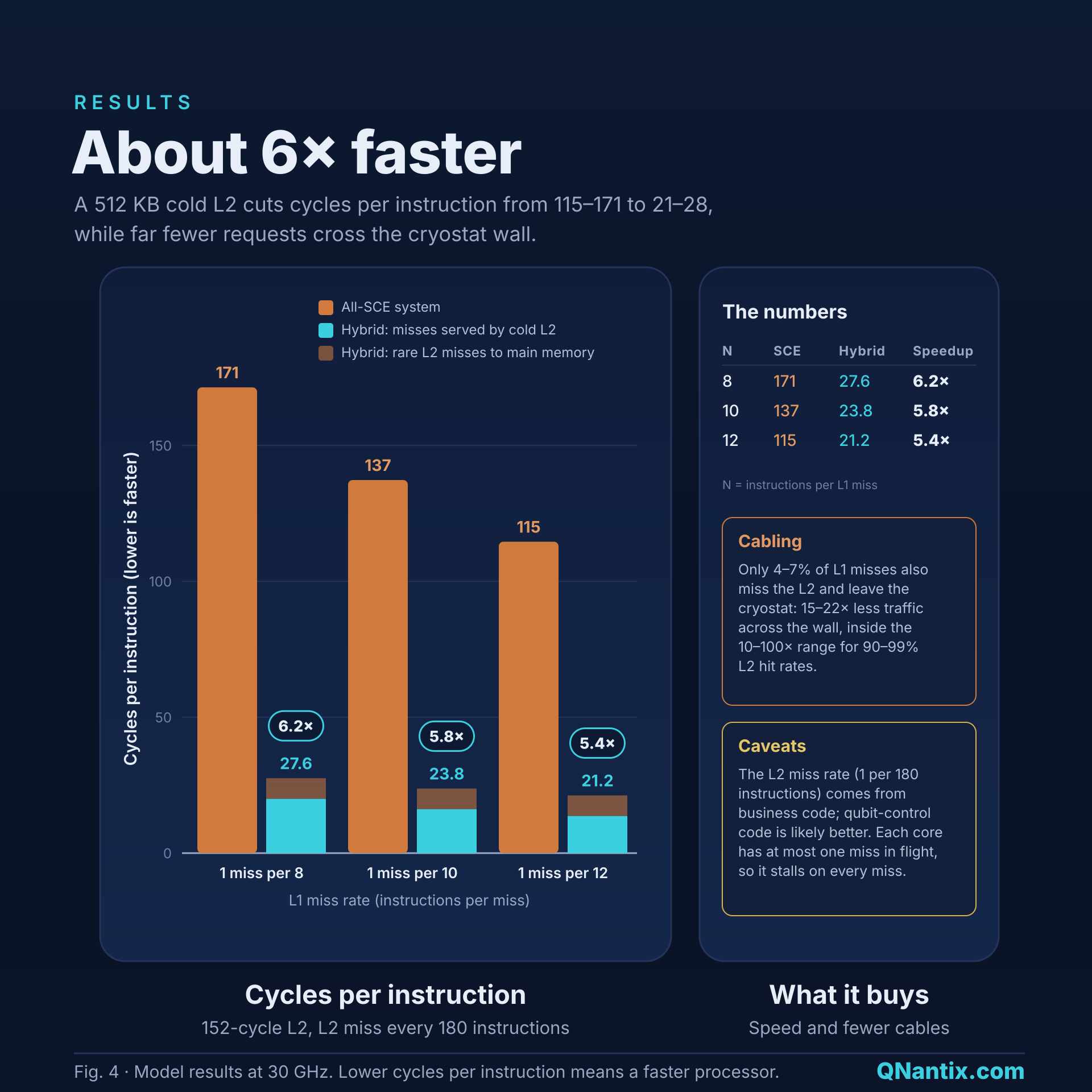
Adding a 512 KB cryo-CMOS memory L2 inside the cryostat makes the superconducting system 5.4 to 6.2 times faster in our model, and cuts the traffic that must cross the cryostat wall by 15 to 22 times.
Speed
| Instructions per L1 miss (N) | All-SCE CPI | Hybrid CPI | Speedup |
|---|---|---|---|
| 8 | 171 | 27.6 | 6.2× |
| 10 | 137 | 23.8 | 5.8× |
| 12 | 115 | 21.2 | 5.4× |
Figure 4 shows where the hybrid’s remaining cycles go. Most come from L1 misses served by the L2 (cyan). A smaller, fixed share comes from the rare L2 misses to main memory (brown). The result holds up when assumptions shift: varying the L2 latency from 135 to 175 cycles moves the hybrid’s CPI by only a few cycles.
Cabling
The number of cables between the cryostat and warm memory grows with how much traffic must cross. In the all-SCE system, every L1 miss crosses. In the hybrid, only L2 misses do.
Our own numbers show how big that difference is. With an L1 miss every 8 to 12 instructions and an L2 miss every 180, only 8/180 to 12/180 of L1 misses, or 4% to 7%, also miss the L2. That means 15 to 22 times less traffic crosses the wall. More generally, an L2 that answers 90% to 99% of requests (its “hit rate”) reduces cabling by 10 to 100 times.
Fewer cables matter twice over. Each cable conducts heat into the cryostat, eating into the small cooling budget of the cold stages. Each also adds cost, space and assembly complexity.
Caveats
- The L2 miss rate of one per 180 instructions comes from studies of business software. Code that controls qubits or processes signals tends to loop over small, predictable working sets, so we expect it to do better.
- These results come from an analytical model, not a built system. They show the size of the opportunity, and the method is the same one long used to design commercial processors.
- Each core here can wait on only one miss at a time. More advanced cores could hide some delay, but the basic advantage of keeping data close remains.
7. The wiring wall in quantum computers
The same principle, keep the work close to where it happens, matters even more in quantum computers. There, the problem is not only speed. It is the sheer number of wires.
Thousands of lines, and growing
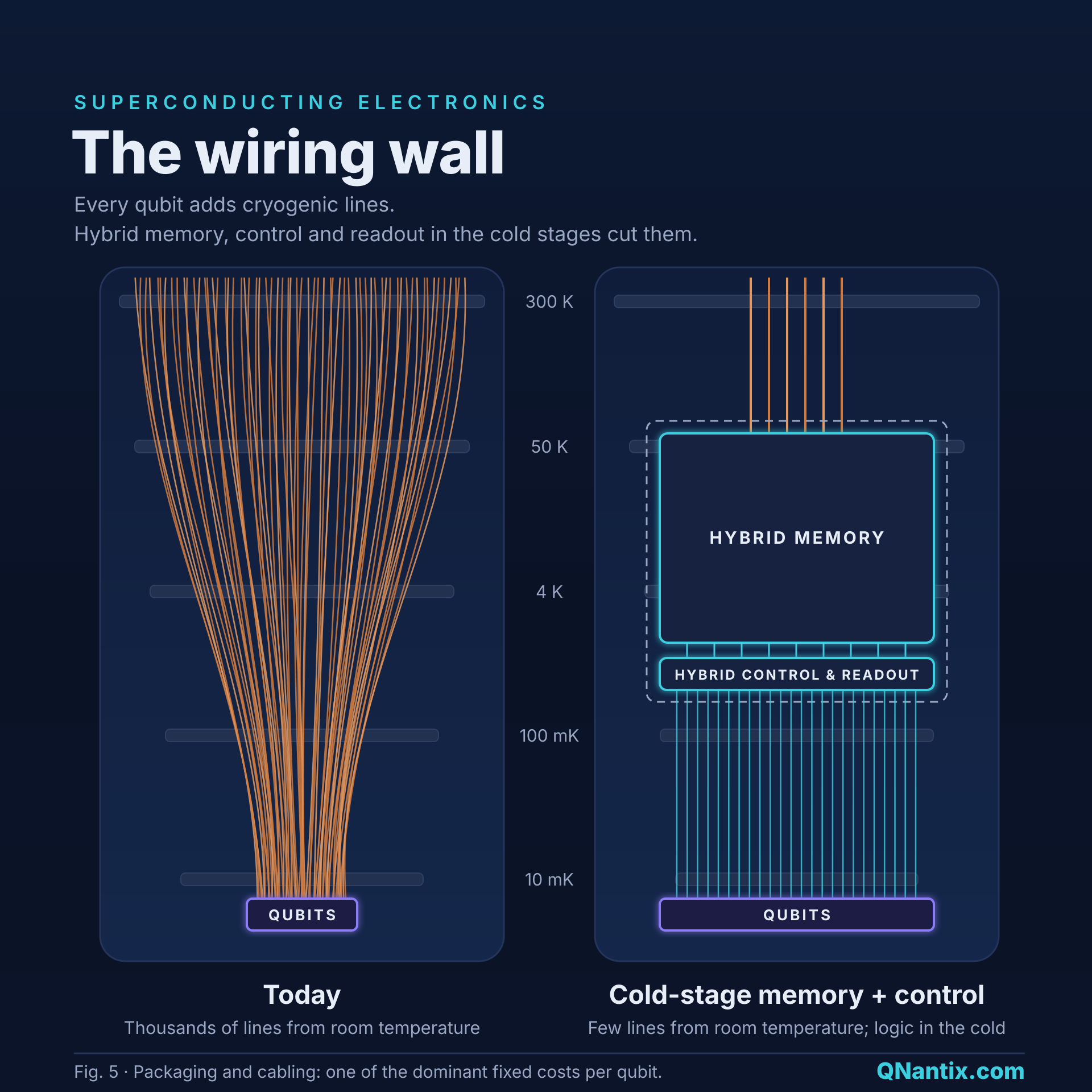
A superconducting quantum computer’s qubits sit at the bottom of the cryostat, near 10 mK. Today, the electronics that control and read them sit mostly at room temperature. Each qubit needs its own control and readout signals, so thousands of lines run from room temperature down the staircase to the qubits, as the left side of Figure 5 shows.
This tangle of cabling is called the wiring wall, and it gets worse as machines grow:
- Heat. Every line conducts heat down into the coldest stages, whose cooling power is only a tiny fraction of a watt.
- Space. Cables and the packages that connect them must physically fit through each stage of the refrigerator.
- Cost. Measured per qubit, packaging and cabling are one of the dominant fixed costs of building a quantum computer.
- Speed. Error correction, which fault-tolerant machines need, requires measuring qubits and responding within microseconds. Every round trip to room temperature eats into that window.
The fault-tolerant quantum computers planned for the end of this decade will need far more qubits than today’s machines. Scaling today’s wiring approach along with them is not practical.
Moving memory, control and readout into the cold
The right side of Figure 5 shows the alternative. Place hybrid memory, control and readout circuits in the cold stages of the cryostat, centered at 4 K. Instructions, calibration data and measurement results then live next to the qubits instead of at room temperature. Short, dense connections run the last step down to the qubits, and only a few lines need to climb to room temperature.
This is the same move the hybrid cache made in Section 5, applied at a larger scale. In both cases, a memory the cold hardware can reach quickly removes most of the traffic that once had to cross the cryostat wall. A breakthrough in dense cold memory would therefore do two things at once: accelerate the classical side of superconducting electronics, and enable real-time control of superconducting qubits.
8. The QNantix approach
QNantix develops memory for cryogenic systems, using three technologies and combining them where each fits best.
| Technology | Strengths | Limits today |
|---|---|---|
| Cryo-CMOS (1–77 K) | Builds on CMOS, the mature technology behind nearly all of today’s electronics; dense memory is achievable now | Uses more power than superconducting circuits |
| Superconducting electronics (SCE) | Lower power and higher performance than cryo-CMOS at cryogenic temperatures | Still immature: low integration density and low manufacturing yield |
| Hybrid | Uses SCE for speed and cryo-CMOS for density | Requires careful design of the boundary between the two |
Two kinds of hybrid
“Hybrid” can mean two things, and QNantix has intellectual property covering both:
- Within a circuit: a single circuit that contains both cryo-CMOS and superconducting devices. This approach is covered by QNantix US Patent 12,744,079.
- Within a system: separate cryo-CMOS and superconducting chips connected to work together, as in the hybrid cache of Sections 5 and 6. QNantix has filed patent applications on this approach.
QNantix’s first product is cryo-CMOS memory for a two-level hybrid cache system, the kind of cold L2 analyzed in this paper. More on our technology
Where it applies
- Quantum computing (10 mK to 4 K): memory close to the qubits for control, readout and error-correction data, as systems grow beyond 1,000 qubits.
- Quantum sensing and defense (below 4 K): storing and processing sensor data in the cold, before it leaves the cryostat.
- Cryogenic AI and high-performance computing (4 K to 77 K): memory for superconducting logic and cryo-CMOS processors that run cold.
9. The long game
Some technologies are embraced immediately. Others need sustained investment, patience and obsessive imagination. Hardware usually moves on a longer timeline than software, and cryogenic hardware longer still.
The cache was one of those patient ideas. Engineers like James Pomerene and Philip Emma worked out how memory hierarchies shape performance long before the industry at large understood it, and today every processor depends on that work. Superconducting computing now faces the same memory wall the first computers did, in a colder setting and with a wiring wall added on top.
The path forward does not require waiting for superconducting memory to mature on its own. Hybrid designs that pair superconducting logic with cryo-CMOS memory can deliver large gains with technology that can be built now, while superconducting memory continues to improve.
QNantix has hybrid semiconductor and superconductor circuit and system IP to get past the wiring wall. We welcome conversations with researchers, system builders and partners.
Contact usGlossary
- Absolute zero:
- 0 K (−273.15 °C), the lowest possible temperature.
- Cache:
- a small, fast memory near the processor that holds copies of what is in use right now.
- CMOS:
- complementary metal-oxide-semiconductor, the standard chip technology in nearly all electronics.
- CPI (cycles per instruction):
- the average number of clock cycles per instruction, including waits for memory. Lower is faster.
- Cryo-CMOS:
- CMOS circuits designed to operate at cryogenic temperatures, about 1–77 K.
- Cryostat:
- a refrigerator that holds equipment at cryogenic temperatures, built as a series of colder and colder stages.
- Error correction (quantum):
- methods that detect and fix qubit errors in real time; required for fault-tolerant quantum computers.
- FDSOI:
- fully depleted silicon-on-insulator, a CMOS manufacturing process well suited to low-temperature operation.
- Fault-tolerant quantum computer:
- a quantum computer that corrects its own errors well enough to run long calculations reliably.
- GHz (gigahertz):
- billions of cycles per second.
- Hit / miss:
- finding (hit) or not finding (miss) the needed item in a cache.
- Hit rate:
- the fraction of requests a cache answers; 1 minus the fraction that miss.
- Hybrid:
- a design combining cryo-CMOS and superconducting electronics, within one circuit or across separate chips.
- Kelvin (K):
- the temperature scale used in science, starting at absolute zero. 300 K is about room temperature.
- L1, L2:
- levels of cache. L1 is smallest and fastest; L2 is larger and somewhat slower.
- Latency (miss penalty):
- the time, in clock cycles, a processor waits for a request to be answered.
- Main memory:
- the large memory holding all of a program’s instructions and data.
- Millikelvin (mK):
- one thousandth of a kelvin.
- Miss rate:
- how often a cache misses, counted per instruction (for example, 0.1 = one miss every 10 instructions).
- Qubit:
- the basic unit of a quantum computer, which can hold a blend of 0 and 1 at once.
- Readout:
- measuring a qubit’s state and sending the result to the control electronics.
- Stored-program computer:
- a computer that keeps its program in the same memory as its data.
- Superconducting electronics (SCE):
- circuits made from materials with zero electrical resistance when cold; very fast and very low power.
- Working set:
- the instructions and data a program actively uses over a stretch of time.